
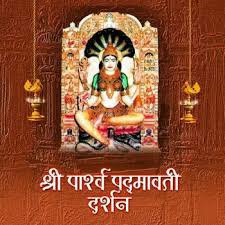
Mother Padmavati is a popular Jain goddess. Among the Yakshis to the 24 Tirthankara, Yakshi Chakreshwari, Kushmandini, Jwalamailini, Ambika and Padmavathi are popular. Of these Goddess Padmavathi happens to be one of the most popular and most worshiped Yakshi in the Jain community. She is also described as Shasan-devi of the 23rd Tirthankara, Lord Parshva.
Humbaj is a hamlet located in Shimoga district in the Indian state of Karnataka. It is also known as known as Humcha or Hamchawadi. It is famous for being home to an ancient temple of Goddess Padmavati, and to the Humbaj Matha meaning seminary or monastery. This is an important institution of the Jain community. Apparently the lake here never dries up and a tree that likewise always remains green. Humca contains one of the most popular Padmavati shrines in the world.
The worship of the Yaksha and Yakshi’s in Jainism varies in different sects and different regions. Yakshi worship predominates the Southern states of India. It is said that the worship of Goddess Padmavathi as yakshi is prominent with the Bispanthy sub sect of Digambars. Digambar means skyclad. Murthipujak sub sect among the Shwetambars also worship Goddess Padmavathi as yakshi.
Deities of Goddess Padmavathi and Lord Parshwanatha glorify the main temple complex at Humcha, Shimoga district, Karnataka, India. The main features are the temple Complex, Jain Mutt, Panchakuta Basadi, Muttina, origin of river Kumudvati and Parshwanatha Idol
DEPICTION: In Jainist religious practice, Tirthankara idols look similar with standard symbolism. One finds snake hoods above the head of Dharanendra Yaksha and Padmavathi Yakshi. This is symbolized with a diamond studded crown. Like wise Lord Parshwanatha is identified with the symbol of a snake and usually we find hoods of snake above the idol.
A snakes hood also covers Mother Padmavati’s head, and she sits on a lotus flower. Often a small image of the Tirthankara is placed in her crown. In addition to this Goddess Padmavathi is said to have four hands. This is called as Chaturbhuje. Her color is golden and her vahana is the snake.
Mythology:-
Jinadatta, the prince of Mathura, fled to south India leaving his home town due to family reasons. Jain monk Muni Siddhantakeerthi advises Jinadatta to carry the idol of Goddess Padmavathi on the horse back and tour the southern parts of India. Reaching Humcha, he took shelter under a Lakki tree. There he is inspired by a dream.
Goddess Padmavathi graces him with thoughts that if she is installed in Humcha, then he may get local support. She too would stay in Humcha. She further instructed him that when iron is touched to the feet of Padmavathi deity, it will be converted into gold. With this wealth, Jinadatta could make Humcha as the capital city.
This prompts Jinadatta to construct a temple dedicated to Goddess Padmavathi and Lord Parshwanatha. His Guru Siddanthakeerthi and his mother settled at Humcha also. Further he married princess Manoradhini of the Kingdom of South Mathura. Humcha is made the capital of his new kingdom.
Everything is moving smoothly but Mother Padvati wanted to test Jinadatta’s devotion. She created two Muttu or pearls at a pond located a few meters away from the temple. Since then this pond is called as Muttina Kere. Kere means tank in Kannada. Of the two pearls one of them was pure and the other was stained a bit. One of persons in the kingdom who found the pearls handed them over to the king.
Now, Jinadatta made two nose rings. The one with pure pearl was given to his wife; Padmavati was given the one with the stained pearl. Later when Jinadatta visited the temple, he was astonished to find the Goddess adorned with pure pearl nose-ring. Padmavati’s divine voice was then heard. The deity was to l loose its divine power of converting the iron into gold. It was to land itself into the well besides the temple.
Jinadatta realized his mistake and pleaded the Goddess for forgiveness. The all-merciful Mother decreed that Jina should install another idol at that place. He was also promised to have her presence felt, Goddess Padmavathi would ensure, the Lakki Tree and the Muttina will never dry; water will be constantly oozing out from the point of origin of Kumudavati River and that when bhaktas are blessed by Goddess Padmavathi, flowers will fall from the right side of the deity..
YAKSHIS:
The feminine form of Yaksha is Yakshi. This concept is an ancient Indian Indian tradition referring to a class of natural spirits who are caretakers of the natural treasures hidden in the earth and tree roots. This concept of Yaksha and Yakshi or Yakshini is existent in Hinduism, Buddhism and Jainism.
TIRTHANKARAS:
The essential goals to human life in Jainist belief is free oneself from worldly sufferings, inner passions and attain liberation. A Jina, Arihanta or Tirthankara is a liberated soul that is freed of the worldly sufferings and inner passions. He or she resides in Siddhaloka or the top of the world. Tirthankaras are worshiped in Jainism as they have liberated themselves by conquering their inner passions and attained moksha. They have expounded the path of liberation and to get an inspiration to attain their state.
Yaksha and Yakshis are found in pairs flanking the Tirthankara idol with the Yaksha on the right and Yakshi on the left as guardian deities. They are regarded as the devotees of the Jinas with supernatural powers. Just like humans they too go through the cycles of birth and deaths but have supernatural powers. As they have renounced the world, they cannot reward devotees. But since they do have supernatural powers, Jains give them a place in the temple as some Yakshis were known for bestowing worldly desires. Progressively, the concept of Yaksha and Yakshi’s became very popular in Jainism.
Please like share and follow
Ankit mehta
Jai jinendra
 jainism in 21st century