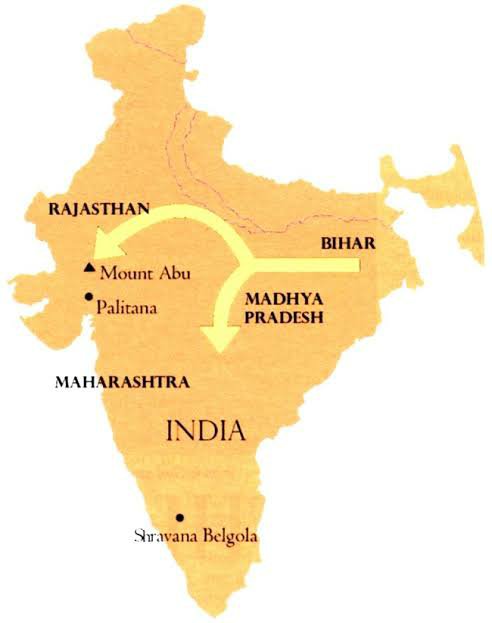
Today there are some six million Jains worldwide, and they represent less than 2% of India’s population. The Jain community in India is centred in Rajasthan and Gujarat. Many migrated to East Africa and from there to Britain, where the community is around 30,000.
Jainism is a philosophy of contemporary relevance, based on the overriding principle of reverence for life. As action, this translates into non-violence and non-possession. Mahavira, the 24th Tirthankara who lived in the 6th century BC, taught that ‘There is nothing so small and subtle as the atom nor any element so vast as space. Similarly, there is no quality of soul more subtle than non-violence and no virtue of spirit greater than the reverence for life’.
This principle extends to all life forms and dictates that Jains observe a strictly vegetarian diet. In India it also finds expression in the tradition of establishing animal shelters or sanctuaries where neglected or threatened animals may be cared for. It also dictates which professions Jains may pursue, as those which violate life or the environment are to be avoided. This extends to a platform of environmental concerns, based on a respect for life and a recognition of the interdependence of life forms; ‘One who neglects or disregards the existence of earth, air, fire, water and vegetation disregards his own existence which is entwined with them’.
Jainism will always be relevant and contemporary in our lives today. Jainism has been ahead of time because the tirthankars (ford makers) had enlightenment or kevalgyana which made them see everything like a film recording, just like a time machine. Jaati smaran talks about remembering your previous birth, which is also relevant today.
Today, people say that Mahavira, or any of the tirthankaras, were in an underdeveloped world, where there was no electricity or modern gadgets. However, samayik (where one becomes closer to the soul by isolating ourselves from daily lives for 48 minutes) was practiced even when there was no watch, because they knew 48 minutes accurately.
Jainism always talks about the theory of karma which also involves the basic common factor among all organisms, which is a single ‘cell.’ Every organism tries to acquire more cells or develop its own cells by mating, procreation or physical acquisition. Every organism also has lifeless cells such as ‘money,’ which helps him gain more cells. This process of acquiring more and more is called as parigrah (accumulation).
Jainism talks about non violence which means that we should try and destruct less in this universe, be content with what he have and learn to give rather than acquire. ‘Aparigraha’ is the essentially the opposite of parigrah which means to stop accumulating. When we talk about acquiring less it also means to ask for less and to be content with the minimal, which involves less destruction, violence and killing. We are taught to do without the worldly luxuries. Global warming also can be healed with this thought by doing away with unwanted luxuries, which produce carbon emissions.
Thus this practice of non-violence and acquiring less serve as practical solutions to major problems such as establishing world peace and combating global warming. Jainism used boiled water for drinking millions of years before packaged drinking water companies thought about hygienic water. Jains also practiced vegetarianism before many realized the health benefits of the lifestyle.
Rishabhdeva, the first tirthankar, taught us the reason to establish ourselves as a civilization. He taught us that we should help each other, cook food in a certain manner and establish a chaturvidh sangh (ford civilization) where saadhu, saadhvi, shraavak and shraavikas existed. We as laypeople are shraavaks and shraavikas. Those who take diksha, or renounce the world, are the saadhus or saints.
Even today, aparigraha is relevant because the more we accumulate, the more we want, but renouncing the world is very difficult. For example, Alexander the Great, on his death bed, requested his doctor to help him live one more day. However, the doctor said he could not. When Alexander said he would give his kingdom to him in return, the doctor still said he could not help him. If Alexander the Great had known the value of his kingdom was not worth a penny, then he would have not wasted his life by acquiring kingdoms. Thus, he requested to all that his palms would face upward toward the sky when he was laid out in his coffin, to look like a beggar, so that the world would know even Alexander the Great went empty handed.
Please like share and follow
Ankit mehta
JAI JINENDRA
 jainism in 21st century