
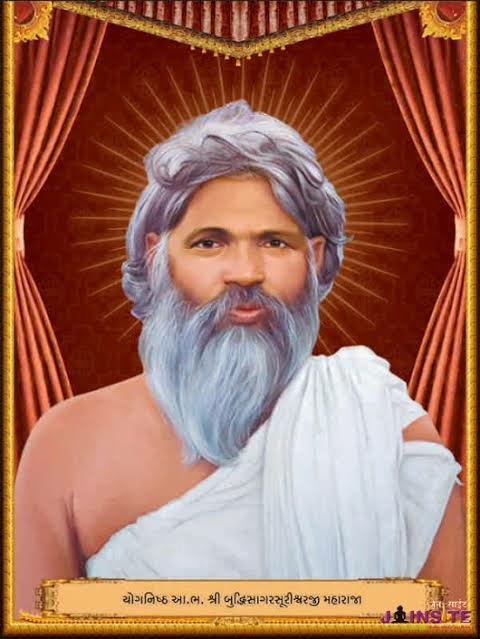
Unending efforts to get knowledge, continuous practices in meditation and creation of spiritual literature-these three meet together like three holy rivers of the Ganges, the Yamuna and the Saraswati in Shri Buddhi Sagar Suriji. He is the great saint and mendicant of this century. He is universally accepted great man of Gujarat.
Birth and Childhood
A religious minded couple strongly believing in non-violence and purely vegetarian was residing at Vijapur town of Mahesana District in Gujarat. Their names were Shivabhai and Ambaben. The couple was well known for their co-operative nature in the whole town. Shivabhai had agricultural land and the family was happy in all respects. A son was born to this couple in 1874, the day of Shivratri on which Lord Shiva is worshipped. He was known as saint Buddhi Sagarji in his later life, but his childhood name was Bahechar. He started his learning at the age of six years in a dusty village-school. He maintained first position up to standard six and was very much loved by his teachers.
Sounds of the future
Every human being is born with deep impressions of his previous births. Bahechar was kind, thoughtful, preferring to stay alone and always ready to serve others. This was his nature since his childhood. At the age of 15 he had saved some Jain mendicants when buffaloes ran after them. At this time he heard the preaching from these Jain mendicants that the beasts also experience pain like human beings if they are beaten and it was a sinful act. He was at once attracted towards Jainism. He used to go to Jain very often to hear the preachings and religious discourses and saints and mendicants. He easily turned to non-violence, forgiveness, broad heartedness, penance renunciation and study of scriptures. He was attracted by high ideas of Jainism. He used to think and meditate. He studied Hindi, English and Sanskrit languages by his own intuition. After sometime he accepted the work of religious teacher at village Ajol. While teaching others, he himself also studied well in religion, history, logic, Yoga and other subjects. He marched on the path of thinking about the absolute and adopted total truth, non-violence. He thought that he would not be able to proceed in studies in this small village and hence he came to Mahesana with the help of Shri Venichandbhai. It was possible here to read and study special books on Sanskrit, Religious-logic and philosophy in large libraries and thereby expand knowledge on all sides.
Acceptance of Renunciation
After sometime, he heard the news of sad demise of his parents and soon he decided to adopt Diksha. At last, he took Diksha in 1901 at Palanpur in the presence of and with the blessings of Shri Sukh Sagarji Maharaj who was the disciple of Shri Ravi Sagarji. Now he became Muni Buddhi Sagar from Bahecharbhai.
Ardent Practitioner of Yoga
From the very beginning of his life he had knowledgeable detachment towards worldly affairs. He strongly believed that spiritual path and practices are the only steps to proceed to the Absolute Truth or Salvation and hence this young mendicant strengthened his practices in meditation. He did not mind to the trifling and unimportant differences in Jainism. He was devoted to high values of very wide Indian culture. He kept himself in loneliness for deeper meditation so that all living beings may get peace on earth and created very simple but high-leveled spiritual literature for common people, which can be read and understood by them very easily. He has, thus, obliged us all very much. He has tried to remove blind faith and unfruitful activities followed out of ignorance in villages and showed the path of true knowledge and high behavior to the uncultured and wandering villagers. He preached the young and the old, the rich and the poor, Jains and non-Jains, men and women without discrimination of caste and creed and showed them the way to true knowledge and salvation.
Practices for spiritual meditation and services to society
After adopting Diksha, he turned to do the works of public welfare after his daily routine deeds of study and religious-rites including meditation. He, therefore, became much popular among the people. Even the rulers ofVadodara, Idar, Mansa, Pethapur etc were impressed by the preachings of Shri Buddhi Sagar Maharaj and they had put up ban on hunting, drinking wine, gambling, violence etc. on certain specified days. They took several vows under the advice of this great saint. The committees of learned awarded him the title of Shashtra Visharad (expert in Scriptures) A mendicant should not stay at one place and accepting this guide-line, Shri Buddhi Sagarji went on moving continuously from place to place and village to village. He was, however, very much attached to three places:
Boriya Mahadev near Vijapur. Here he met a dedicated mendicant Shri Sadanand Saraswati who imparted advanced knowledge and gave better guidance to Shri Buddhi Sagarji Maharaj.Idar- a famous and old town of Sabarkantha District. Here there are rows of small mountains, lonely caves, dilapidated and ruined temples etc which attracted this Yogi. He spent several weeks in this region for deep meditation and muttering of religious phrases and hymns on rosary.Shri Kesariyaji holy place of south Rajasthan. Here is also deep forestry where loneliness is very easy. He could meet here Baba Rushabhdev- Kala Baba who was respected by the people of all the 18 castes throb whom he could get deeper experience of spiritual peace. He spent many days in this region for meditation in loneliness
Became Acharya
He was awarded the title of Acharya in 1914 in the presence of hundreds of Jains and many Jain Sanghs. Acharya Shri Buddhi Sagarji was mainly interested in expansion of knowledge and good behavior in society, how to increase self-confidence, create brotherhood and make the people aware of their duties towards their country, community, society, region, animals and the world at large. He had come to Ahmedabad respecting the pressure of Sheth Lallubhai Rayji of Ahmedabad after the monsoon of 1907 and preached many groups of Jains and non-Jains. He held spiritual discourses with Lala Lajpatray, ruler of Limbdi, Collector and Commissioner of Ahmedabad and other little-attached class of people belonging to Hindu, Swami Narayan, Sthanakvasi and Arya Samaj. He cleared off their doubts and explained them the thoughts of Truth, non-violence, renunciation and liberality covering the eternal facts of this and future lives.
Expansion of Spiritual knowledge and service to literature
He established Adhyatma Gnan Prasarak Mandalan institution for expansion of spiritual knowledge of Mansa in 1909 which is the day of special respects for knowledge (Gnan Panchmi) with a view to convey the message and preachings of Lord Mahavir to common people in distant small villages. The institution worked according to its name and has published about 125 great and small books on Gujarati, Hindi, Sanskrit and Madadhi and the special aspects of this series of books are that the books include the subjects of philosophy, history, yoga, spiritual practices like meditation, muttering of holy names, non-speaking, commentaries, translations, biographies, sketches and so on. These books are not for the people of particular or special classes or castes but are meant for the lowest to the highest persons like little learned persons, pleaders, doctors, professors, learned persons, historians, mendicants, renunciators etc.
Please like share and follow
Ankit mehta
Jai Jinendra
 jainism in 21st century